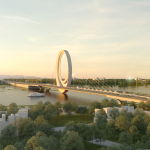
As part of Hanoi’s development strategy, with the Red River waterfront designated as the city’s central urban axis, the Hanoi People’s Committee approved the project of a bridge linking Hoan Kiem District and Long Bien District, named after one of the greatest generals in world history: Tran Hung Dao (Hưng Đạo Đại Vương). This bridge is one of six across the Red River and Duong River, identified as key transport links to gradually shift population density from the crowded southern bank — particularly the Old Quarter — to the northern bank, which holds vast development potential.
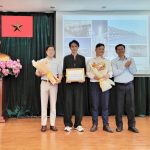
In the Tran Hung Dao Bridge Architectural Design Competition, the VTCO–KIDOHU Consortium submitted three proposals inspired by General Tran Hung Dao and the cultural heritage of the Tran Dynasty. Among them, the design THĐ 18 (VT0002), themed “Hào khí Đông A – The Spirit of the Sacred Dragon”, was awarded the Second Prize.
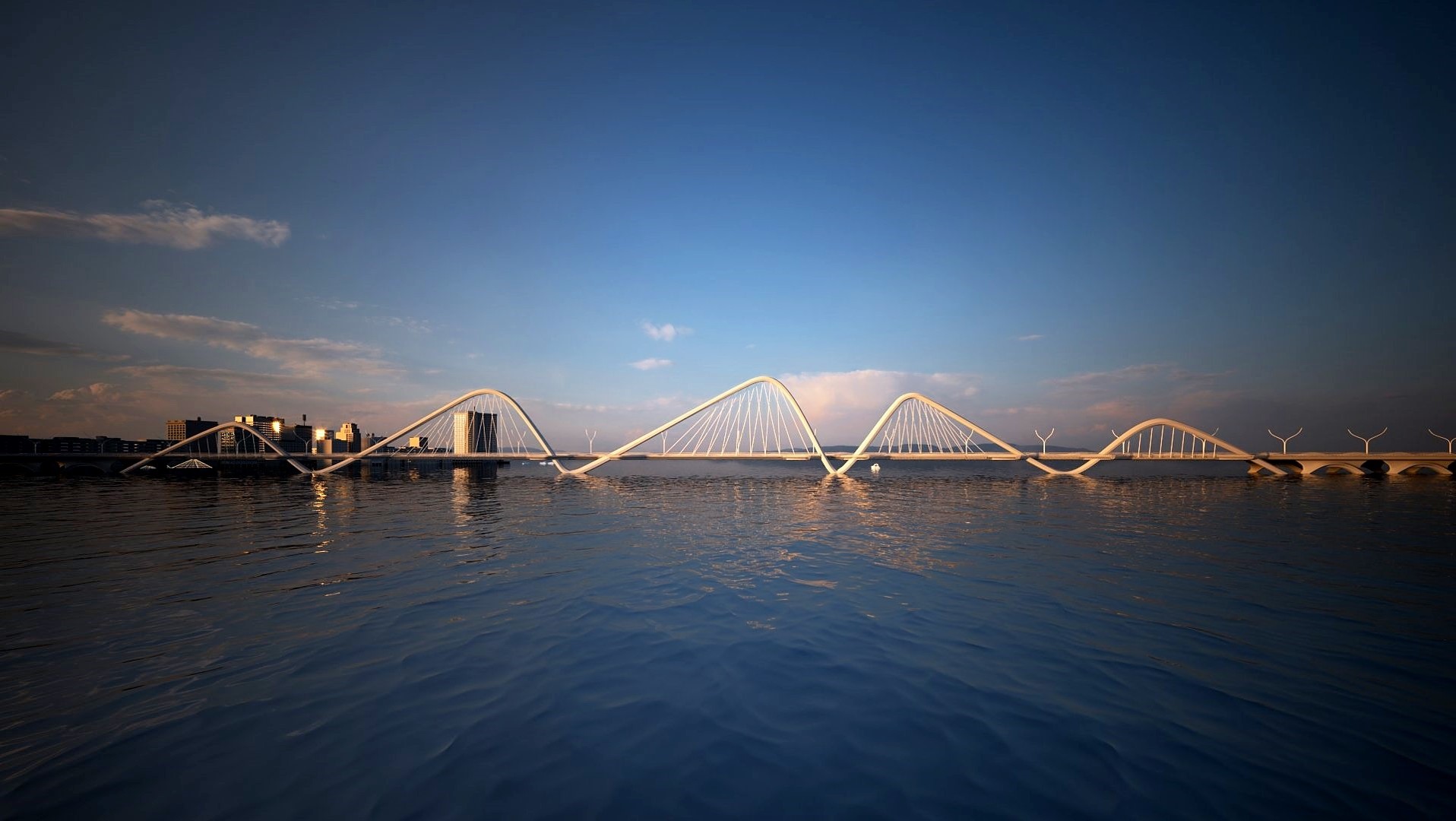
Tran Hung Dao Bridge – Concept won second prize
Hào khí Đông A – The Enduring National Spirit
Hào khí Đông A originates from the Tran Dynasty’s family name (the Sino-Vietnamese character Trần 陳 is composed of “Đông” 東 and “A” 阿), symbolizing the indomitable spirit that led the Tran people to victory in three wars against the Mongol Empire — the most powerful military force of its era.
The design was envisioned not as a mere transport structure, but as an architectural monument infused with history and culture. The goal was to ensure that every child, elder, youth, or visitor crossing the bridge would remember Vietnam’s proud legacy.
The concept draws on the imagery of the Tran Dynasty’s dragon: free yet decisive, powerful yet graceful, embodying the bold, magnanimous spirit of Hào khí Đông A. The dragon itself is also the emblem of ancient Thang Long (Hanoi), symbolizing prosperity, fortune, and the nation’s spirit of rising.
The VTCO team, already authors of major award-winning works such as the Phat Tich – Dai Dong Thanh Bridge (under construction in Bac Ninh), Thu Thiem 4 Bridge, and Can Gio Bridge (First Prize, Ho Chi Minh City), brought their expertise to this ambitious design.

Comprehensive Functional Design
The Tran Hung Dao Bridge proposal was designed with full functionality, including:
- Riverside parks and access points: four pedestrian stairways on the Hoan Kiem side, two stairways on the Long Bien side, and bicycle access.
- Maintenance walkways and VIP observation decks, ensuring security and national defense.
- Scenic viewpoints for sightseeing, watching fireworks, and observing river traffic.
Integrated systems for fireworks and musical water performances, conveying the mission of the architect: to bring joy and happiness to all users — pedestrians, drivers, river travelers, and park visitors alike.
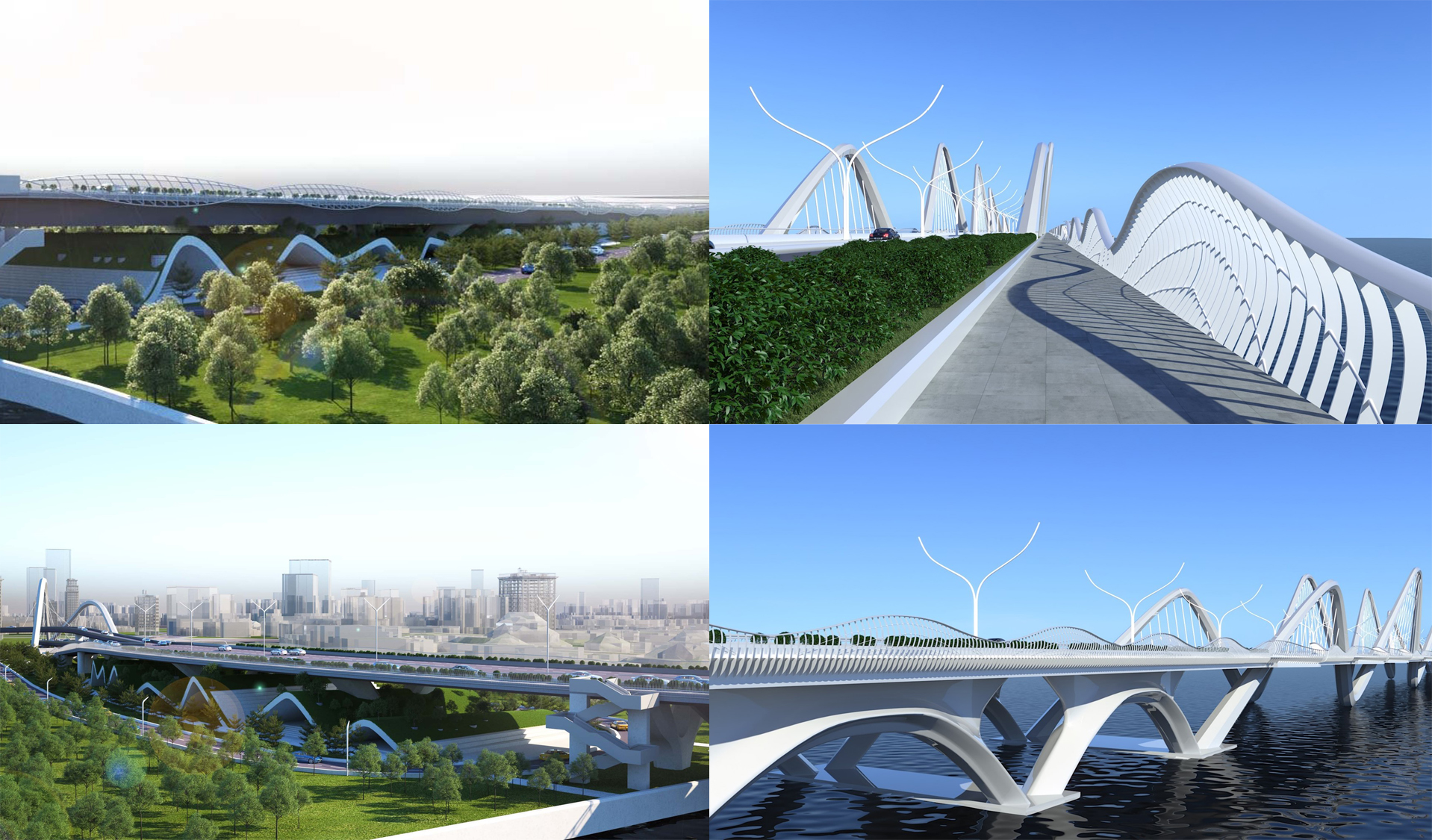
The bridge was designed as a steel-arch structure, with permanent reinforced concrete piers. It consists of five main spans, with a total length of 590 meters and a deck width of 33 meters.
Because the river section at Long Bien is nearly 1 kilometer wide, yet limited to a maximum elevation of 47 meters above water level due to Gia Lam Airport’s aviation restrictions, a single-span bridge would appear overwhelmed by the river. Therefore, VTCO proposed a five-span arch design, balancing the scale of the water surface while accommodating regional river transport needs.
The design layout integrates five architectural components:
- Arch blocks (base and body)
- Piers (which also form the arch supports)
- Double-layered balustrades functioning as wind barriers and viewing platforms
- Cable-stay systems
- Riverside parks at both ends
The arch structure was proposed in white composite-coated steel, maximizing light reflection and enabling striking illumination — promising spectacular “light shows” above the Red River.
Urban Traffic Integration
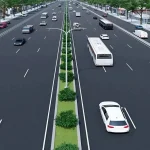
In parallel with the bridge’s design, VTCO paid great attention to traffic solutions around the bridge to mitigate congestion. Drawing lessons from Hanoi’s Ring Road 2 – Nga Tu So junction, where high-volume traffic caused serious bottlenecks, VTCO proposed dedicated flyover ramps at Nguyen Khoai Street:
- Traffic toward Vinh Tuy Bridge would turn left via a separate ramp.
- Traffic toward Chuong Duong Bridge would turn right onto its own ramp.
This system distributes traffic flow, significantly reducing pressure at Tran Hung Dao junction.
Various interchange options were studied for both Hoan Kiem and Long Bien sides. Ultimately, VTCO adopted a priority-based interchange design, with straight-through traffic (Tran Hung Dao – Long Bien) prioritized, followed by right-turn movements, left turns toward Vinh Tuy Bridge, and left turns from Tran Khanh Du – Nguyen Khoai.

Hoan Kiem intersection

Long Bien intersection
Traffic flow is regulated by intelligent signal systems synchronized with vehicle-counting cameras. In case of congestion, green phases can be extended, temporarily converting the junction into a roundabout to relieve pressure. Properly managed, the Tran Hung Dao interchange would also reduce congestion at the Chuong Duong Bridge roundabout, enhancing connectivity from Hanoi’s inner city to Long Bien, Dong Anh, and neighboring provinces.
Awakening the Nation’s Aspiration
Through a modern architectural language infused with traditional culture, the design creates a unique visual effect: five consecutive arches radiating at an 8-degree angle, their form combining light and dragon imagery. The result is the vision of a golden dragon stirring waves on the Red River, echoing the pulse of Hanoi — a thousand-year-old capital in constant motion.
From the time of the Hung Kings until today, Vietnam has endured over 4,000 years of history. By honoring and preserving the cultural legacy of our ancestors as a foundation for future growth, we believe that the Tran Hung Dao Bridge will become a true reflection of Vietnam’s construction achievements, proving that the Hào khí Đông A — the spirit of resilience and unity — will never fade from this land of heroes.
Tran Hung Dao Bridge is more than infrastructure — it is an emblem of history, culture, and national aspiration, designed to become a defining landmark of modern Hanoi.